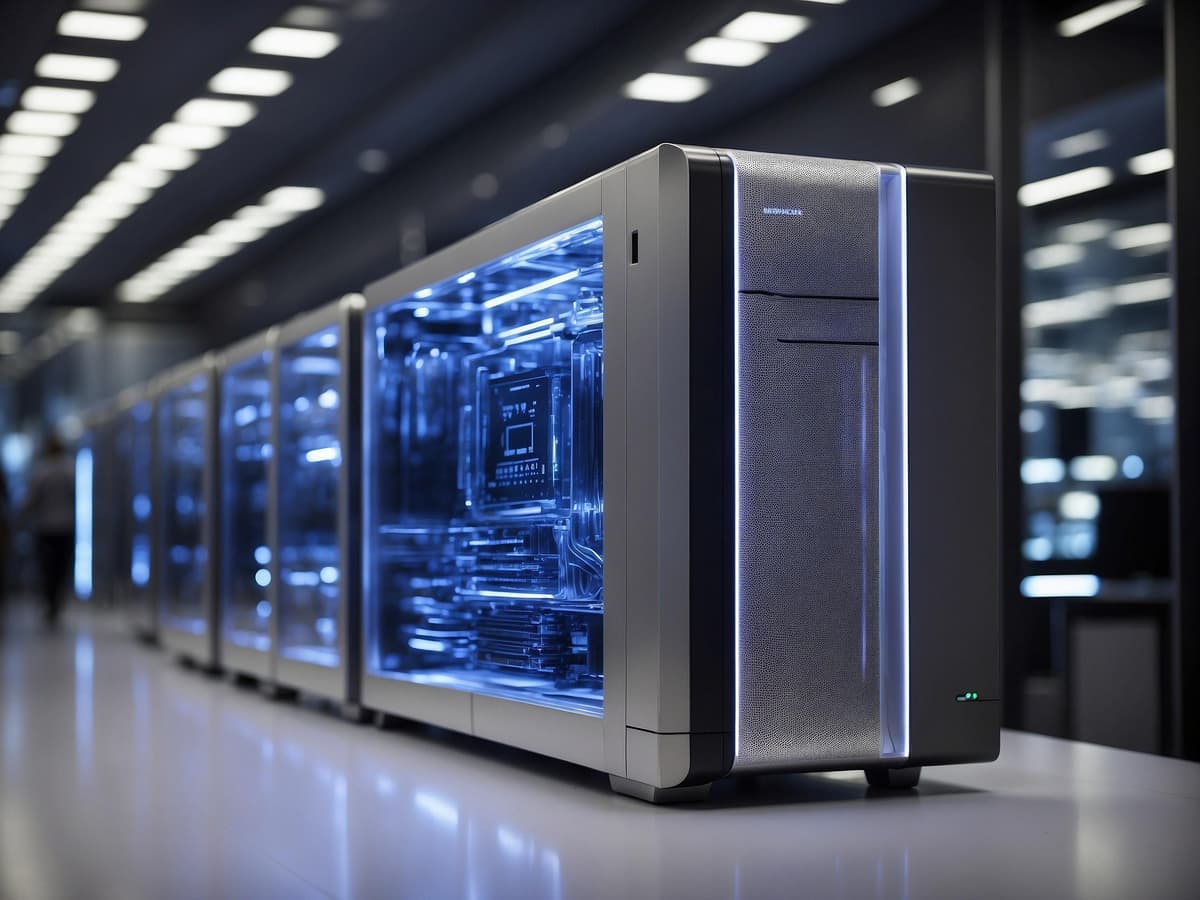
Vertiv Holdings Co. is one of the purest expressions of the GZC Bottleneck-to-Ticker framework in public markets — a company whose business is structurally defined by the physical constraints of AI deployment rather than by market sentiment or narrative momentum. The scaling of AI from research compute to global infrastructure deployment has created a collision between abstract computational demand and the concrete physics of heat, power, and physical space. AI clusters generate heat at densities that conventional air cooling cannot manage. They consume power at concentrations that challenge building electrical systems. They require integration, commissioning, and service by companies with the technical expertise to operate at AI compute specifications. Vertiv provides power delivery, thermal management, and infrastructure solutions for exactly these requirements — and the customers who need them do not have the option to delay procurement when AI deployment timelines are contractually committed.
From GZC's perspective, Vertiv is not a technology company benefiting from AI sentiment. It is an infrastructure manufacturer and service provider that has been structurally positioned at the intersection of rising AI cluster density and the limited pool of suppliers capable of meeting the technical and manufacturing specifications those clusters demand. The non-discretionary nature of the spend is the thesis. Once a data center operator commits to building an AI cluster — whether for hyperscaler capacity expansion or for an enterprise AI deployment — the power delivery and cooling systems are not optional budget items. They are prerequisites. Without them, the GPUs cannot operate. Without the GPUs operating, the economic justification for the entire capital program is lost. Vertiv's products are structurally required, not discretionarily purchased.
The demand backdrop GZC monitors is multi-dimensional. Hyperscaler AI cluster expansion drives large-volume procurement of Vertiv's liquid cooling and power distribution systems — the most technically demanding and highest-value products in Vertiv's portfolio. Colocation data center operators expanding AI hosting capacity represent a second demand channel. Enterprise and government customers deploying AI at their own facilities represent a third. The combination of these three demand streams creates revenue visibility that is both larger and more durable than a single-customer or single-segment concentration would suggest.
Key Metrics Snapshot
| Field | Detail |
|---|---|
| Ticker | VRT |
| Sector | Critical Digital Infrastructure |
| Theme | AI Data-Center Power + Cooling Bottleneck Enabler |
| Investment Bias | Bullish |
| Time Horizon | 12–36 months |
Green Zone Capital Thesis
GZC prioritizes physical bottlenecks because they become non-negotiable as AI scales. Vertiv benefits from four structural constraints that have been steadily tightening as AI cluster density has increased — creating a demand environment where Vertiv's manufacturing and delivery capacity is the binding constraint, not customer demand.
Power constraints are the most acute. As GPU power consumption per rack has escalated from 10–20 kW per rack in traditional data centers to 50–100+ kW per rack in high-density AI configurations, the electrical infrastructure required to deliver and distribute that power has become a specialized engineering problem. Standard UPS systems, power distribution units, and switchgear are not designed for these load densities — Vertiv's products are. The customer base that needs AI-grade power infrastructure has a limited set of qualified suppliers, and qualifying a new supplier is a multi-year process that does not happen on the timeline of an AI deployment program.
Thermal constraints drive the shift from air cooling to liquid cooling — one of the most significant technical transitions in data center infrastructure history. Air cooling reaches its practical limits around 20–30 kW per rack; above that, liquid cooling becomes physically necessary, not merely preferred. Vertiv's liquid cooling solutions — direct liquid cooling, immersion cooling, and rear-door heat exchangers — address this constraint directly. As average rack density in AI facilities continues to rise, the addressable market for liquid cooling expands, and Vertiv's early technical leadership in this category translates into design wins at new facilities that will generate revenue for years.
Time-to-deploy constraints are the third structural driver. AI cluster procurement cycles are compressed by competitive urgency — hyperscalers and AI companies are racing to build capacity before competitors do. Delays in power or cooling systems delay the entire cluster. Vertiv's ability to manufacture and deliver at scale, and to provide integration and commissioning services, makes it a preferred vendor not just on technical merit but on delivery reliability. In a market where deployment speed matters, a vendor with demonstrated delivery track record commands pricing power.
Fundamental Analysis | Bull Case
Vertiv's Q3 2025 results provided the financial evidence that validates the structural thesis with specificity:
- Net Sales: $2.676B (up 29% YoY)
- Organic Orders: Up approximately 60% YoY; book-to-bill approximately 1.4x
- Backlog: Increased to $9.5B
Orders and backlog are the forward demand signals GZC cares most about in infrastructure businesses. Backlog represents committed procurement — customers who have signed contracts and are waiting for delivery. A $9.5 billion backlog provides multi-quarter revenue visibility that does not depend on new orders to sustain. The 60% organic order growth reflects the acceleration in AI infrastructure buildout committing new capital to Vertiv's products. A book-to-bill above 1.0 means orders are coming in faster than deliveries are going out — the business is becoming capacity-constrained rather than demand-constrained.
Management's explicit framing of demand as AI-driven infrastructure investment — combined with commitments to expand manufacturing and services capacity — reflects that Vertiv is recognizing the structural nature of the demand and investing accordingly. Manufacturing capacity expansion is a forward indicator of revenue confidence: companies do not build manufacturing capacity they do not expect to need.
The NVIDIA alignment is strategically significant. AI factories are increasingly standardized around NVIDIA's architecture — specific rack configurations, power delivery specifications, and cooling requirements defined by NVIDIA's reference designs. As Vertiv aligns its product portfolio with NVIDIA reference architectures, it effectively becomes a preferred supplier for every facility built to NVIDIA standards. This creates a relationship between Vertiv's revenue and NVIDIA's accelerator deployment that compounds over time.
Technical Analysis | Market Structure
VRT trades with high beta because the market treats it as a real-time AI capex sentiment indicator — the stock amplifies both AI infrastructure optimism and AI capex uncertainty in its price action. GZC accepts this volatility because the underlying demand driver is physical buildout, not narrative sentiment. Physical infrastructure commitments, once made, must be followed through — the volatility in VRT's stock price does not reflect volatility in its order book.
The structural price action shows a pattern consistent with a market repricing a business undergoing fundamental transformation. Base construction at lower levels gave way to a significant expansion phase as the AI data center buildout accelerated. The subsequent consolidation and volatility represent the market adjusting the multiple as rate sensitivity and execution questions arose — but the fundamental demand picture, visible in orders and backlog, remained intact through the price volatility.
GZC watches the primary demand evidence — orders, backlog, and book-to-bill — rather than the stock price for thesis validation. Price volatility creates accumulation opportunities when the fundamental signal remains positive.
Investment Strategy
| Treatment | Core BTT Framework holding — power and cooling bottleneck for AI data centers |
| Accumulate | Constructive pullbacks while order and backlog growth trajectory holds |
| Add | Evidence of liquid cooling design win acceleration or manufacturing capacity expansion announcements |
| Reassess | Sustained order deceleration or book-to-bill declining below 1.0 |
| Risk | AI capex cycle moderation or customer concentration risk |
Summary
Vertiv is a flagship GZC framework holding: AI is not only software, it is an infrastructure supercycle constrained by power, cooling, and deployment capacity at every tier of the buildout. The physical reality of AI at scale — heat dissipation, electrical distribution, integration complexity — creates a set of non-discretionary requirements that Vertiv is uniquely positioned to satisfy at the scale and speed the market demands.
With strong order growth, a growing backlog, explicit alignment to AI-driven infrastructure demand, and ongoing manufacturing capacity investment, VRT remains a high-conviction enabler of the next phase of the AI economy. The volatility inherent in a high-beta infrastructure name is the price paid for exposure to one of the clearest structural demand stories in global capital markets.
This publication is for informational and educational purposes only and does not constitute investment advice, an offer to sell, or a solicitation to buy any securities. All opinions reflect the current views of Green Zone Capital and are subject to change without notice. Past performance is not indicative of future results. Investing involves risk, including possible loss of principal. For additional information or official materials, please visit greenzonecapital.com or contact info@greenzonecapital.com.